Luvantic is an independent course aggregator. We may earn a commission when you click through.
Which Data Course Should You Take First?
Compare three beginner-friendly data courses by time, practical SQL work, certificates, and the skills each one actually builds.
Quick Picks
Best first step: Microsoft Azure Data Fundamentals.
Best for learning SQL: Query and Modify Data with Transact-SQL.
Best for project practice: Kteam Practical SQL.
All three courses focus on data skills, but they solve different problems. One gives you vocabulary in under an hour, one builds a structured SQL foundation, and one puts SQL inside a student-management project.
Start With the Skill, Not the Certificate
Most beginners make the same mistake: they choose a course because the title sounds career-ready, then discover that it assumes SQL, databases, or cloud vocabulary they have never seen. A better sequence starts with the gap in front of you.
- Need basic data vocabulary? Choose the 57-minute Azure path.
- Need a repeatable SQL foundation? Choose the 5-hour-45-minute Transact-SQL path.
- Need a project you can discuss in an interview? Choose Kteam's practical SQL course.
Free access is visible for the two Microsoft Learn paths, while the supplied Kteam listing does not show a price. That means the Microsoft options are easier to evaluate upfront. Certificate details also differ: Microsoft Learn clearly shows achievement progress and XP, but the supplied pages do not confirm a formal certificate for either Microsoft path.
Giới thiệu về dữ liệu cốt lõi của Microsoft Azure
The 57-minute Microsoft Azure Data Fundamentals path is the quickest way to stop feeling lost around data terminology. It is marked beginner level, contains two modules, and awards 1,500 XP on Microsoft Learn. That makes it a low-risk starting point before you commit several evenings to SQL. The limitation is depth: this is orientation, not a portfolio project or a full analyst curriculum. Choose it if databases, analytics, and cloud data all sound blurred together and you need a clean map first. Microsoft lists the learning path and its duration on the official course page.
Truy vấn và sửa đổi dữ liệu bằng T-SQL
Five hours and 45 minutes across six modules gives this Microsoft Learn path far more room to build usable SQL habits than the short Azure overview. It is also labeled beginner level, so you do not need to arrive with advanced database knowledge. The practical focus is querying and modifying data with Transact-SQL, which is closer to the day-to-day work behind reporting and database analysis. Compared with the 57-minute path, it demands more time but gives you a skill you can keep practicing. The supplied listing confirms 5,900 XP, though it does not confirm a formal certificate.
The difference between the first two picks is simple: the Azure path explains the territory, while the Transact-SQL path asks you to work inside it. If you already understand tables, databases, and basic data types, skip the orientation and start with SQL.
When Practice Matters More Than Platform Vocabulary
Course length is not the same as learning value. A short introduction can prevent confusion, but a project gives you something concrete to explain, troubleshoot, and revisit later.
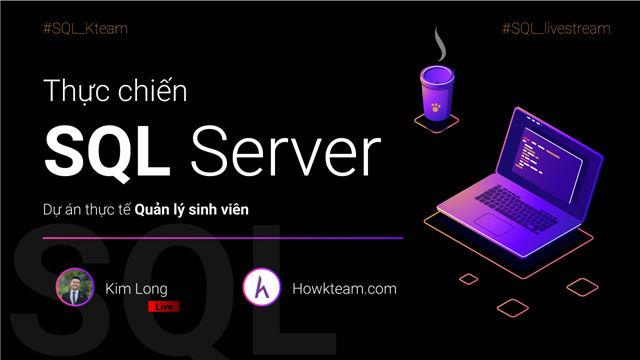
Khóa Thực chiến SQL - Dự án quản lý sinh viên
Kteam's Practical SQL course uses a student-management project as its organizing idea, which gives beginners a more tangible reason to write queries than a sequence of disconnected examples. That project framing is the strongest reason to choose it over the Microsoft overview. It may also feel more approachable for Vietnamese learners because the course page is presented in Vietnamese. The supplied listing does not show a price, duration, certificate, or full module breakdown, so check those details before enrolling. Pick this one if you learn by building and want a project-shaped path rather than cloud terminology.
Kteam fills the hands-on gap, but the missing course details matter. Microsoft Learn publishes the duration, module count, level, and XP directly; the Kteam information supplied here does not. That makes Microsoft easier to plan, while Kteam may be more motivating for learners who need a concrete scenario to stay engaged.
For a broader comparison, Microsoft’s official Azure Data Fundamentals learning path confirms the short introductory structure, and the Transact-SQL learning path lists the longer six-module sequence. The Kteam course is available through the official Kteam course page.
Common Mistakes That Slow Beginners Down
Choosing cloud branding before learning data basics
Azure is useful, but the platform name should not decide your first course. If you cannot explain the difference between a table, a database, and a query, the short fundamentals path is more useful than jumping straight into specialized tools.
Confusing XP with a professional credential
The Microsoft pages show XP and achievement progress. That is useful evidence of course completion inside Microsoft Learn, but the supplied information does not promise a formal industry certification. Treat the learning path as preparation, not as a substitute for a separate certification exam.
Watching SQL without writing SQL
Passive viewing creates false confidence. After each module, write a query, change it, break it, and fix it. The Kteam project format can help here because a student-management database gives the exercises a consistent context.
Starting with a project that is too large
A full analytics portfolio can wait. First, learn to filter records, combine tables, update data carefully, and explain what your query returns. The Microsoft Transact-SQL path is the most structured route in this group for building that base.
Your Three-Step Decision Framework
- Start from zero: Spend 57 minutes on Microsoft Azure Data Fundamentals, then decide if the data vocabulary feels clear.
- Know the basics and want analyst skills: Take the six-module Transact-SQL path. Its 5 hours and 45 minutes are the most balanced investment here.
- Need motivation through a build: Choose Kteam's student-management project, but confirm price, duration, and certificate terms on the course page before paying.
My recommendation is straightforward: begin with Microsoft Azure Data Fundamentals if databases are new to you, then move to Transact-SQL. Choose Kteam instead when a project keeps you learning better than a structured platform curriculum. None of the supplied listings proves a formal certificate, so judge them first by the skill you can demonstrate afterward.
Once SQL feels comfortable, the next question is which programming language should support your analytics work. Our guide to JavaScript or C#: Which Beginner Course Comes First? can help you make that choice without starting from scratch.