Luvantic is an independent course aggregator. We may earn a commission when you click through.
SQL First: Three Practical Paths Into Data Analytics
Compare three beginner-friendly SQL and Azure data courses, from a 57-minute primer to a hands-on student-management project.
Microsoft’s 5-hour-45-minute Transact-SQL learning path is my top pick here because it gives beginners enough practice to move beyond definitions without demanding a full semester. The shorter Azure course is better as a first orientation, while Kteam’s student-management project has the most practical feel but less visible detail about duration, price, and certification.
I evaluated all three as starting points for data science and analytics. The surprise was how different “beginner” can mean: one course introduces the vocabulary in under an hour, another builds a structured SQL sequence, and the third appears to learn through a concrete database project.
Best overall: Transact-SQL learning path.
Fastest orientation: Azure Data fundamentals.
Most project-focused: Kteam SQL course.
The structured route: enough SQL to build momentum
SQL is the common thread across all three choices, but Microsoft’s longer path gives it the most room to breathe. The official Transact-SQL learning path lists six modules, a beginner level, and an estimated completion time of 5 hours and 45 minutes. That is long enough to create a routine, short enough to finish in a week of evening study.
Truy vấn và sửa đổi dữ liệu bằng T-SQL
The six-module structure makes this the strongest all-round starting point. At 5 hours and 45 minutes, it goes far beyond a quick vocabulary lesson, yet the beginner label keeps the entry barrier low. The page shows 5,900 XP and a learning-path format, which gives progress a clearer shape than the shorter Azure primer. The limitation is practical: the supplied listing does not show a price, certificate outcome, or project portfolio, so learners should confirm those details before treating it as a job-ready credential. I’d choose this for a career changer who can study several hours this week and wants SQL practice before moving into dashboards or Python.
The Microsoft path is the better learning sequence, but it is not automatically the better first click. Someone who has never encountered databases may prefer a short explanation of the basic ideas before committing to six modules. That is where the Azure course earns its place.
Giới thiệu về dữ liệu cốt lõi của Microsoft Azure
A 57-minute course split across two modules is unusually easy to test before investing serious time. The official Azure Data fundamentals path is marked beginner level and awards 1,500 XP, so it can introduce core data concepts without overwhelming a complete newcomer. Compared with the Transact-SQL path, it is far too short to become a working SQL course; its value is orientation, not depth. Pick it if you are deciding between analytics, databases, and cloud data work, or if you need a low-pressure first session before starting a longer curriculum. The listing does not state a price or certificate result, so do not assume the XP equals an industry certification.
That short format also exposes the main trade-off in this comparison: speed can reduce friction, but it cannot replace repetition. After the Azure introduction, I would move directly into the longer Microsoft path rather than treating the 57 minutes as a complete analytics foundation.
The hands-on alternative: learn SQL through a project
Project-based learning can be more memorable than a sequence of explanations. Kteam’s course is built around a student-management project, which gives SQL a concrete setting instead of leaving queries as isolated exercises.
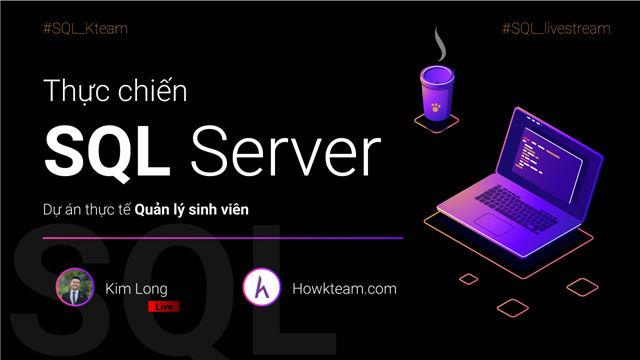
Khóa Thực chiến SQL - Dự án quản lý sinh viên
The student-management project gives this course the clearest real-world anchor of the three. Instead of learning SQL only as syntax, a learner can connect tables, queries, and database decisions to a recognizable system. That makes it appealing to a beginner who loses motivation in abstract lessons. The supplied page content does not reveal the course length, price, module count, certificate, or assessment method, so the comparison has an important blind spot. It also appears more narrowly focused than Microsoft’s broader learning path. Choose Kteam if you learn by building and can verify that the project includes guided exercises rather than only demonstrations.
Kteam is the pick I would investigate before enrolling, not blindly purchase. Its project framing may produce stronger portfolio evidence than a completion badge, but the available listing does not provide enough information to judge the full learning experience. Microsoft is more transparent about time, level, modules, and XP, which matters when you are planning a study schedule.
There is another useful distinction. The two Microsoft paths are official training resources, while Kteam’s listing is a dedicated course page from a separate learning platform. That does not make one automatically better, but it changes what you should verify: access terms, instructor support, downloadable materials, and whether the finished project can be shown to employers.
Who should pick what?
- Choose Transact-SQL if you want the clearest structured route, have roughly six hours available, and need practical SQL foundations before moving into analytics tools.
- Choose Azure Data fundamentals if you are completely new to data, have less than an hour to test the subject, or are still deciding which data career direction interests you.
- Choose Kteam SQL if a student-management project will keep you engaged, you prefer learning by building, and you are willing to confirm price, duration, and certificate details first.
My honest favorite is Microsoft’s Transact-SQL path. It has the best balance of structure and manageable scope, and the six-module format gives you a more credible learning routine than a single short primer. Start with Azure if the subject feels unfamiliar, then use Transact-SQL to build depth. Choose Kteam when a project is the difference between finishing and abandoning the course.
Once you know your starting point, the next decision is sequencing SQL, Python, spreadsheets, and visualization. Which Data Course Should You Take First? maps that order for different beginner goals.